
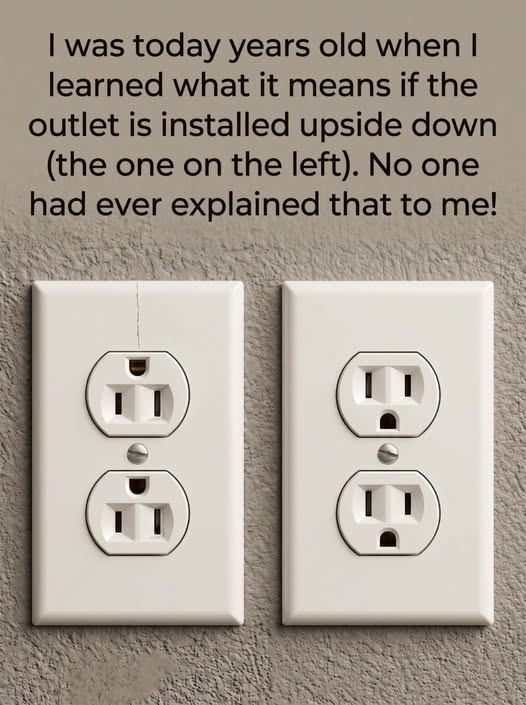
There are electricians and electrical professionals who prefer the grounding opening to be positioned at the top.
One reason sometimes given is the potential safety benefit involving a partially inserted plug and a falling metal object.
The argument is that the grounding contact being above the energized contacts may reduce the likelihood of certain accidental contact scenarios.
However, this is not a universal rule, and receptacle orientation requirements and accepted practices can vary by jurisdiction and installation.
That’s why you may find perfectly legitimate installations using either orientation.
What If My Outlet Is Upside Down?
If the receptacle is working normally and there are no signs of damage, the fact that it’s upside down isn’t necessarily a reason to panic.
You don’t need to immediately turn off your entire house because one outlet has the ground opening on top.
Instead, look at the bigger picture.
Does the outlet feel loose?
Is there discoloration?
Does it make noise?
Does it smell hot or burnt?
Does a breaker or GFCI trip repeatedly?
Are plugs fitting properly?
If everything appears normal, orientation by itself isn’t proof of a problem.
Should You Turn the Outlet Around?
If you’re simply bothered because one outlet doesn’t match the others, resist the temptation to open it yourself unless you’re qualified to perform electrical work safely.
An outlet is connected to an energized electrical circuit, and even seemingly simple electrical work can present a serious shock or fire hazard.
If you want the receptacle changed or you’re concerned about how it was installed, have a qualified electrician inspect it.
That’s a much better approach than assuming you know why it was oriented that way.
Frequently Asked Questions
Is an upside-down outlet installed incorrectly?
Not necessarily. Receptacle orientation can vary depending on local practices, electrician preference, building requirements, or the purpose of the circuit. Orientation alone doesn’t prove incorrect installation.
Does an upside-down outlet mean it’s on a special circuit?
It can sometimes be used as a visual identifier, but there is no universal rule that says an upside-down receptacle always indicates a special circuit.
Is ground-up safer than ground-down?
There are arguments for installing the grounding opening at the top because of certain plug-and-object contact scenarios, but orientation is only one small part of electrical safety. Proper wiring and protection are far more important.
Can an outlet work normally if it’s upside down?
Yes. A properly installed receptacle can operate normally regardless of whether the grounding opening is above or below the blade slots.
Does upside-down mean the polarity is reversed?
No. Physical orientation doesn’t tell you whether a receptacle is correctly wired. A receptacle can face either direction and still be correctly or incorrectly wired.
Should all outlets in my home face the same direction?
They don’t necessarily have to. Consistency can look nicer and make certain installations easier to recognize, but different orientations aren’t automatically a problem.
Why would an electrician install only one outlet differently?
It could have been installed as part of a repair, replacement, remodeling project, or as a visual identifier. Without knowing the history of the electrical installation, you can’t determine the reason from orientation alone.
When should I call an electrician?
Call a qualified electrician if an outlet is hot, loose, damaged, discolored, buzzing, sparking, smells burnt, repeatedly trips a breaker or protective device, or otherwise behaves unusually.
The Bottom Line
So, why are some wall outlets installed upside down?
Because there isn’t just one reason.
An electrician may install a receptacle with the grounding opening at the top because of a preferred installation practice, a local convention, a particular circuit arrangement, a desire to distinguish a receptacle, or simply because that’s how the outlet was installed during a repair.
And sometimes there may be no special reason at all.
The important thing to remember is that an upside-down outlet isn’t automatically an unsafe outlet.
Don’t judge an electrical installation by appearance alone. What matters is whether the receptacle is correctly wired, properly grounded where required, securely installed, and appropriately protected.
So the next time you notice that one strange outlet staring back at you from the wall, don’t immediately assume somebody messed up.
It may have been installed that way deliberately.
Or it may simply be one of those little household details that makes you stop and wonder, “Wait… why is that one different?”
And now you know there’s more to the story than simply being “upside down.”