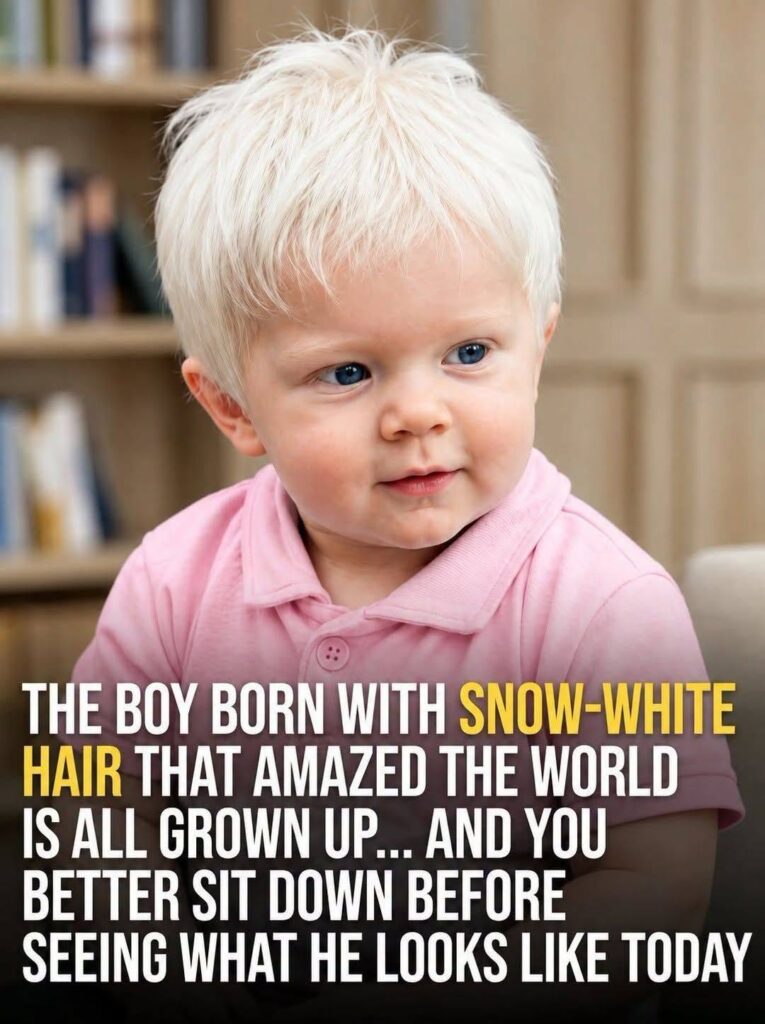
When photographs of a baby boy with remarkably snow-white hair began circulating online, people around the world were captivated by his unusual appearance. His pale hair, bright eyes, and adorable face made him stand out from other newborns, and many people wondered how a baby could be born with hair that looked almost completely white.
Years later, the same question continues to attract attention: What happened to the little boy, and what does he look like today?
One widely reported story involves a Hungarian boy named Bence, whose unusually white hair attracted international attention after his birth in December 2015. However, the photograph accompanying the viral headline does not, by itself, establish that the child pictured is Bence or show his current appearance.
A Baby Whose Appearance Surprised Everyone
Most babies are born with hair that ranges from dark brown and black to lighter shades of blond or red. Bence attracted attention because his hair appeared exceptionally white from birth.
His unusual appearance prompted questions from people who had never seen a newborn with such light hair. Some wondered whether it was caused by a medical condition, while others simply admired how distinctive he looked.
According to contemporary reports about Bence, doctors did not consider his appearance evidence of albinism, and his unusual hair color was not regarded as a sign of illness.
His story became an example of how naturally occurring differences in human appearance can capture widespread public interest.
Why Can a Baby Be Born With White Hair?
Hair color is primarily determined by melanin, a pigment produced by specialized cells called melanocytes. The amount and type of melanin present in the hair influence whether it appears black, brown, blond, red, or white.
Several factors can explain unusually light hair at birth.
Genetics: Inherited characteristics influence how much pigment a person’s hair produces. Some people naturally have exceptionally light hair because of their genetic makeup.
Albinism: This is a group of inherited conditions involving reduced melanin production. Depending on the type, albinism can affect the hair, skin, and eyes, and it may cause vision difficulties or increased sensitivity to sunlight.
Other pigmentation differences: Certain genetic variations can affect hair pigmentation without necessarily indicating a serious health problem.
A photograph alone cannot establish which explanation applies to a particular child. A medical professional would need appropriate clinical information to assess an individual case.
Did His White Hair Mean Something Was Wrong?
See more on the next page