
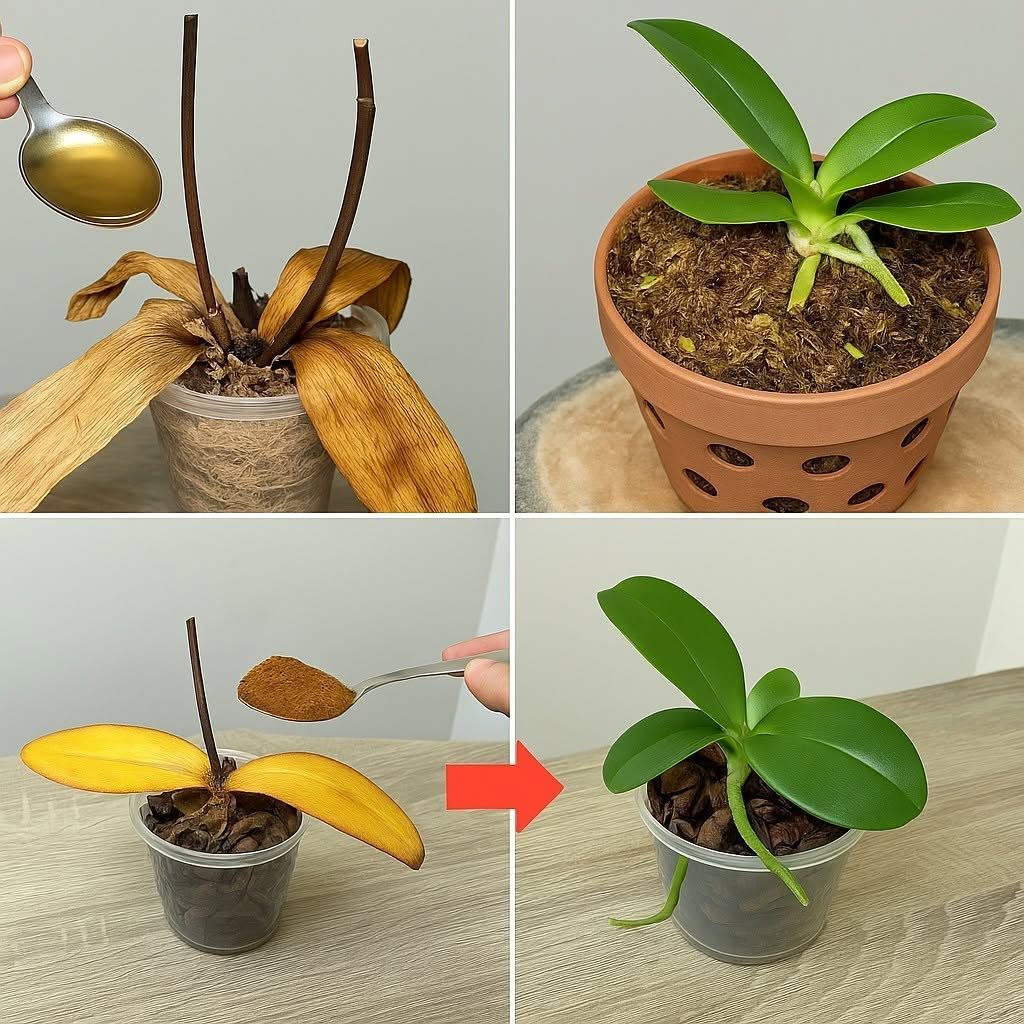
When an orchid starts losing roots, many plant owners immediately search for a miracle ingredient that can bring it back to life.
You may have seen advice recommending that you sprinkle one spoonful of a kitchen ingredient, powder, or fertilizer onto dead orchid roots and watch the plant suddenly recover and bloom all year.
Unfortunately, there is no reliable ingredient that can revive roots that are already dead.
But an orchid with damaged or rotting roots can sometimes recover if the underlying problem is corrected and the remaining healthy roots are protected.
First, Check Whether the Roots Are Really Dead
Before throwing an orchid away, examine the roots carefully.
Healthy orchid roots are generally:
- Firm rather than mushy
- Green when hydrated
- Silver, gray, or white when dry
- Able to hold their shape when gently touched
Dead or severely damaged roots are more likely to be:
- Brown or black
- Soft and mushy
- Hollow or collapsed
- Easily broken or separated
Don’t remove a root simply because it looks gray or silver. Many healthy orchid roots naturally appear pale when they are dry.
Remove Rotten Roots Carefully
If several roots are clearly mushy and rotting, they should generally be removed so the remaining healthy tissue has a better chance of recovering.
Use clean, sharp scissors or pruning shears.
Cut away the soft, damaged portions and keep firm, healthy roots whenever possible.
Afterward, avoid repeatedly cutting or handling the roots. Orchids need time to recover from root damage.
Don’t Sprinkle Fertilizer Onto Damaged Roots
One of the most common mistakes is assuming that a severely weakened orchid needs more fertilizer.
It doesn’t work that way.
Fertilizer provides nutrients; it does not regenerate dead root tissue.
Applying concentrated fertilizer directly to damaged roots can actually make the situation worse by increasing the concentration of dissolved salts around already-stressed tissues.
Once the orchid begins producing healthy new roots, a suitable orchid fertilizer can be introduced according to its label directions.
What About Cinnamon?
Cinnamon is frequently recommended online for orchids because of its association with antifungal properties.
There is some logic behind using a small amount of cinnamon on certain fresh cuts, but it is not a root-revival treatment.
Cinnamon can also be drying, so covering healthy or emerging roots with large amounts of it is not a good strategy.
If you choose to use it after pruning, it should never replace proper orchid care, and excessive application should be avoided.