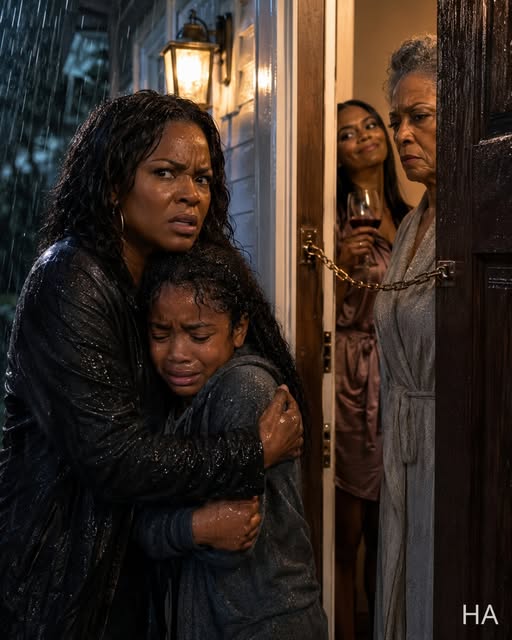
You stood in the storm with your daughter shaking against your chest, staring at the closed door of the only home Hannah had known since your divorce.
Rain ran down your face, into your collar, under your scrubs. Your shoes filled with water. Your hands were numb. But none of that mattered compared to the way Hannah’s teeth chattered against your shoulder.
“Mom,” she whispered, “why did Grandma do that?”
You could not answer.
Because there was no answer a child should have to carry.
Your mother, Lorraine, had changed the locks while you were working a twelve-hour emergency room shift. She had left your eleven-year-old daughter outside in a Florida thunderstorm for five hours. She had done it so your stepsister Brittany and her unemployed husband could move into the largest bedroom.
And then she had called you a stranger.
You looked toward the garage.
Your belongings were piled there in black trash bags, cardboard boxes, and wet laundry baskets. Hannah’s school backpack was on the concrete floor, soaked through. Her stuffed rabbit, the one your father gave her before he died, lay half out of a garbage bag, one ear dragging in rainwater.
That was when your shock became something else.
Not rage.
Rage burns too fast.
This was colder.
Cleaner.
A nurse knows when panic stops being useful. A nurse knows when the body enters a different mode: assess, stabilize, act.
You pulled Hannah closer.
“Come on, baby. We’re going to the car.”
“But our stuff—”
“Not now.”
“My rabbit—”
You walked into the garage, grabbed the soaked rabbit, squeezed rainwater from its fur, and tucked it under Hannah’s arm.
“Now.”
Your mother’s silhouette appeared behind the living room curtains.
Watching.
Not helping.
Brittany’s shadow joined hers.
You saw the movement of a wineglass near the window.
They thought this was the ending.
They thought the rain, the locks, the chain, and the garbage bags meant they had finally pushed you out of the family story.
They had forgotten one thing.
Your father had trusted you with the truth.
You got Hannah into the passenger seat, wrapped your spare hoodie around her, and turned the heater up as high as it would go.
Her lips were pale.
You touched her cheek, then her fingers.
Too cold.
Not frostbite cold, but cold enough to make every medical instinct in you scream.
“Mom,” she said again, voice tiny, “did I do something wrong?”
You closed your eyes for one second.
Only one.
Then you opened them and cupped her face.
“No, Hannah. Listen to me. Adults who hurt children are the ones who did wrong. Not the child.”
Her eyes filled.
“But Grandma said we don’t live there.”
You looked through the windshield at the house.
Your father’s house.
The house where you had changed his oxygen tubes. The house where you had slept on a recliner beside his hospital bed. The house where he had gripped your hand three nights before he died and whispered, “Don’t let them make you leave before you read what I left.”
At the time, you thought he meant the letter.
Now you knew he meant more.
“We do live there,” you said softly. “And we’re going to prove it.”
You drove straight to Gulf Coast General, the hospital where you worked.
Not to finish your shift.
To have Hannah examined.
Your supervisor, Dana, was waiting near the ambulance bay with fury on her face. She had called you eight times after you ran out mid-shift.
“Elena, what the hell happened?”
Then she saw Hannah.
Her face changed instantly.
You did not have to explain.
ER nurses know what a child in shock looks like.
Within minutes, Hannah was wrapped in warm blankets, sipping heated apple juice, while one of the pediatric doctors checked her temperature, lungs, pulse, and hands.
Dana stood beside you, arms crossed.
“Who left her outside?”
You stared through the glass at your daughter.
“My mother.”
Dana’s jaw tightened.
“How long?”
“Five hours.”
“Jesus.”
“Changed the locks too.”
Dana turned toward you slowly.
“On your house?”
You looked at her.
“My father’s house.”
That was not the same answer.
And Dana was smart enough to hear it.
The doctor documented mild hypothermia risk, exposure, emotional distress, and the fact that Hannah had been locked out of her residence during a storm. A social worker came next. Then a hospital security officer. Then, because Dana made one call you were too exhausted to make, a deputy from the county sheriff’s office arrived before midnight.
Deputy Ramirez was calm, broad-shouldered, and tired in the way good officers often are. He took your statement in a small consultation room while Hannah slept under three blankets down the hall.
“My mother and stepsister changed the locks while I was working,” you said. “My daughter came home from school. Her key didn’t work. She called them. They didn’t answer. She waited outside in the storm until she finally called me.”
Deputy Ramirez wrote everything down.
“You said you live at the property?”
“Yes.”
“For how long?”
“Three years.”
“Do you pay rent?”
“No. I paid utilities, groceries, my father’s medical supplies, home repairs, property tax assistance, and caregiving.”
He looked up.
“Caregiving?”
“My father had pulmonary fibrosis and heart failure. I moved in after my divorce to help him. I took care of him until he died six weeks ago.”
“And your mother owns the house?”
You paused.
That was the question.
That was the old lie.
The lie Lorraine had repeated at every family dinner.
Your father bought this house for me.
This is my house.
Elena should be grateful she has a room.
Brittany deserves space too.
You opened your soaked work bag and pulled out a plastic folder.
Inside was the first thing your father had left.
A sealed envelope.
You had opened it the night after his funeral and cried so hard you could not finish reading.
Now you unfolded it with steady hands.
“My father told me to read this if my mother tried to force me out.”
Deputy Ramirez waited.
You handed him a copy.
The letter was in your father’s careful handwriting.
Elena,
If you are reading this, Lorraine has probably tried to make you feel like a guest in the home you saved. I am sorry I did not correct this loudly enough while I was alive. I was tired, and that is not an excuse.
This house is not hers. It is yours.
When you moved back in, I transferred the deed into a trust naming you as trustee and Hannah as future beneficiary. Lorraine has a lifetime occupancy arrangement only if she does not attempt to remove, endanger, or harass you or Hannah. If she does, the agreement terminates.
Brittany knows nothing because she hears only what benefits her. Lorraine knows enough to be dangerous.
Call Mr. Whitaker. Do not argue with your mother. Do not beg. Do not leave quietly.
You were not my backup child. You were the one who stayed.
Love, Dad.
Deputy Ramirez read it once.
Then again.
His expression changed.
“You have the deed?”
You nodded.
“My father’s attorney has the certified copy. I have scans.”
“Attorney’s name?”
“David Whitaker. Naples office.”
Ramirez looked through the glass toward Hannah.
“Mrs. Carter, based on what you’re telling me, this may not be a simple family dispute.”
“No,” you said. “It isn’t.”
At 12:47 a.m., from the hospital parking lot, you called David Whitaker.
You expected voicemail.
He answered on the third ring.
“Elena?”
His voice was old, gravelly, and very awake.
“I’m sorry. Did I wake you?”
“No,” he said. “I’ve been expecting this call since your father died.”
That sentence nearly broke you.
“My mother changed the locks,” you said. “Hannah was outside in the storm for hours.”
Silence.
Then his voice turned cold.
“Is the child safe?”
“At the hospital.”
“Good. Stay there. I’m coming.”
“You don’t have to—”
“Yes,” he said. “I do.”
Forty minutes later, David Whitaker arrived at Gulf Coast General in a wrinkled suit, holding a leather briefcase and the expression of a man who had been waiting years to dislike your mother professionally.
He brought certified documents.
The trust.
The deed.
The occupancy clause.
Your father’s medical directive.
Your caregiving agreement.
Copies of checks you had written for utilities, repairs, and medical expenses.
And one document you had never seen before.
A notarized statement from your father dated three months before his death.
David slid it across the table.
“Your father insisted on this.”
You read it slowly.
Then your breath caught.
I, Thomas Hale, state that my daughter Elena Carter has provided primary care, financial support, and household management for the past three years. My wife Lorraine Hale has repeatedly expressed intent to remove Elena and her minor child from the property after my death and transfer use of the residence to Brittany Marsh. This is against my wishes.
Your hands shook.
David’s voice softened.
“He knew.”
You swallowed.
“He never told me everything.”
“He was ashamed.”
You looked up.
“Of what?”
“Of allowing Lorraine to treat you as less while depending on you most.”
The words went into you like a blade.
Because they were true.
Your father had loved you.
You knew that.
But love without protection had left bruises too.
David turned to Deputy Ramirez.
“Officer, the legal owner and trustee of the property is Elena Carter. Lorraine Hale’s occupancy rights appear to have been terminated tonight by conduct that endangered a minor child and excluded the trustee from the property.”
Ramirez nodded slowly.
“Can you provide certified copies?”
David tapped the briefcase.
“Already made.”
You stared at them both.
“What happens now?”
David looked at you.
“What should have happened before the rain. We take you home.”
At 2:06 a.m., three sheriff’s vehicles pulled into the driveway of your father’s house.
You sat in your car with Hannah asleep in the back seat, wrapped in hospital blankets. Dana had insisted you take them. She also insisted you call her if your mother so much as raised her voice.
David stood beside Deputy Ramirez at the front door.
You got out slowly.
Your scrubs were dry now, but your hair was still damp. Your body ached from adrenaline. Your heart pounded as if you were the one about to be arrested.
The porch light came on again.
This time, your mother opened the door wider.
No chain.